SAMUEL PALMER R.W.S. (1805 – 1881)
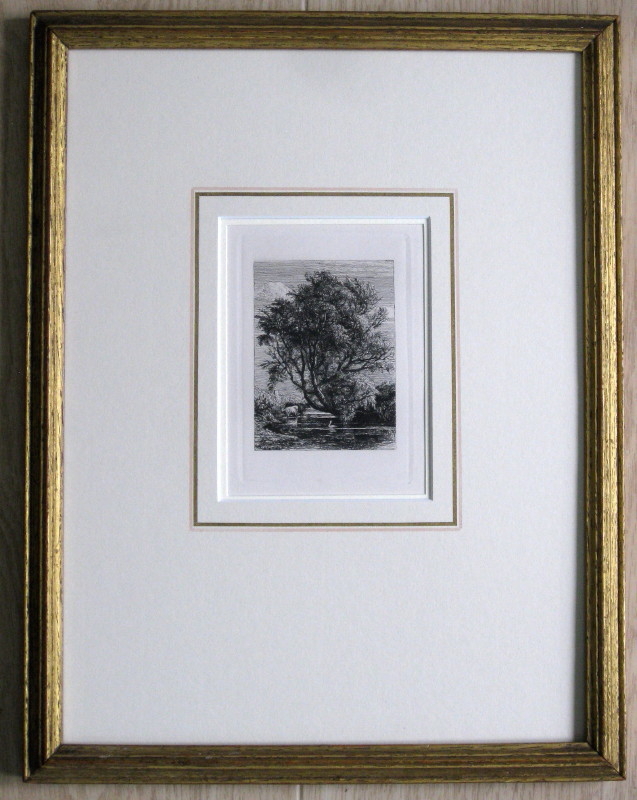
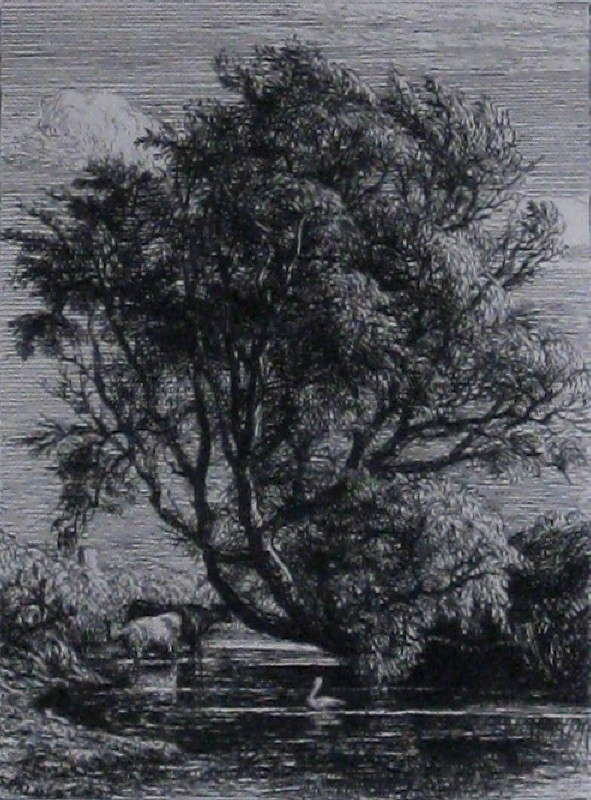
“The Willow” 1850.
Original Etching signed in
the plate. Plate I/ii.
The present etching comes from the large paper
impression as first issued in
the special Limited Edition of “The Life and
Letters of Samuel Palmer”
by A.H. Palmer 1892. This edition was limited to 130 copies
Plate size 4 5/8” x
3 3/16”.
Etched surface 3 17/32”
x 2 5/8”.
Signed and dated 1850 in the plate.
In a period frame finished
in gold leaf over oak and fitted with ultra violet filtering glass.
Overall framed size 14 ½” x 11 ¼”. IMAGE IMAGE
_______________
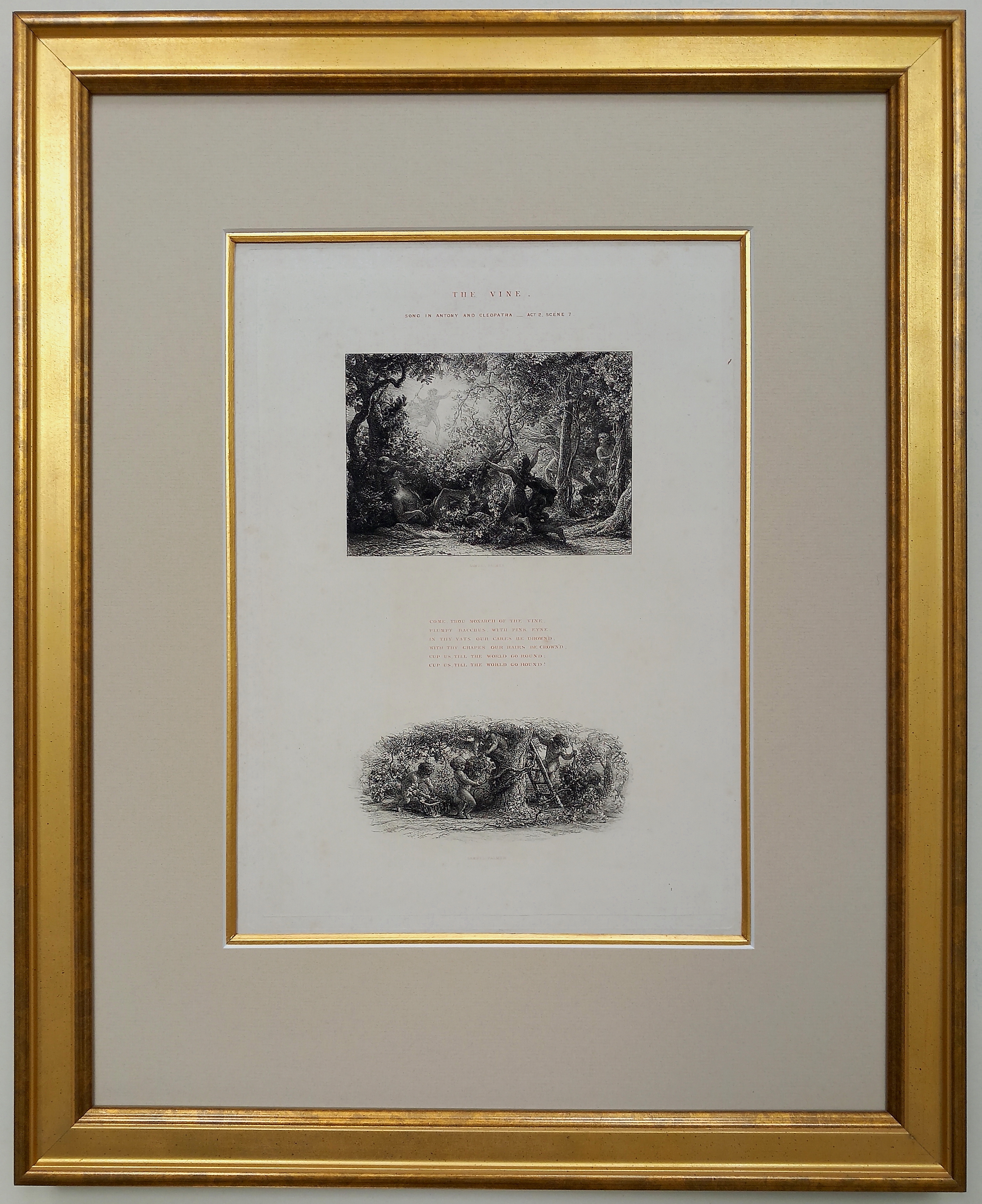
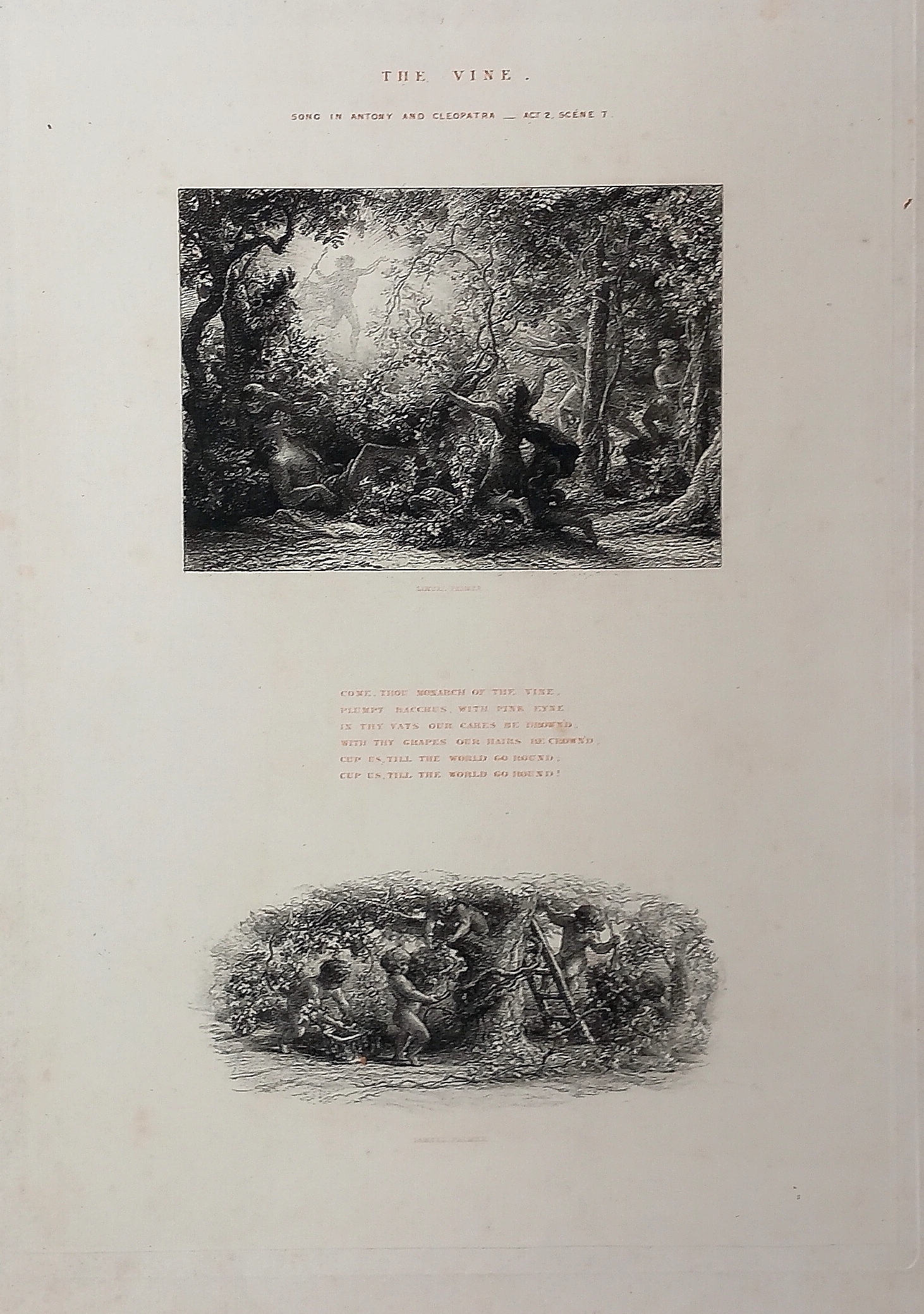
“The Vine or Plumpy Baccus”
1851 – 1852
Original Etchings - Two images on one sheet.L5iv/iv
The rarest of Palmer’s plates. Published by
The Etching Club 1853. Edition of 225
“The Vine” illustrates the song in Act II Scene V11
of “Antony and Cleopatra”
Come thou monarch of the vine
Plumpy Baccus with pink eyne:
In thy vats our cares be drown’d;
With thy grapes our hairs
be crown’d;
Cup us till the world go round
Cup us till the world go round
Large paper edition with writing in terracotta
Upper subject 3 1/2” x 5” (89mm x 128mm). Lower
image 2 ¾” x 5” (70mm x 128mm)
Plate size 11 7/8” x 8
½” (298mm x 216mm). Sheet size 17 ½” x 11 ¾” (445mm x 295mm)
Overall framed size 20” x 16 ¼” (510mm x 413mm)
Framed using ultra-violet filtering low reflect glass
Examples of this etching can be found in the
collections of The Victoria and Albert Museum; The New York Metropolitan Museum
of Art;
The Fitzwilliam Museum, Cambridge; The Paul Mellon
Collection; Herbert F. Johnson Museum of Art, Cornell University, Philadelphia
(Full sheet but with part of the lower left hand corner missing and small tears at the top of the
sheet all well outside the plate)
Photo of the unframed sheet available on request IMAGE IMAGE
Samuel Palmer
was born in 1805 at Newington. He was the son of a bookseller and was one of
the most original landscape painters of the British School. He first exhibited at the Royal Academy in
1819. The most important early influences on his life were Stothard, Varley,
Linnell, Mulready and, above all, Blake, whom he met in 1824. In that year he and his father were living in
Shoreham, Kent, the inspiration for his most perfect primitive and visionary
work. For a time
he formed one of the "Ancients" who gathered there around Blake. In 1837 he married Linnell's daughter Hannah and they went to Italy, returning in 1839. Thereafter he attempted to make a living by
teaching and exhibiting, and made sketching tours throughout Britain,
particularly in Devon, Cornwall and North Wales. He attempted to simplify his work, taking de
Wint as a model, and worked up many of the careful drawings made in Italy. He
was elected Associate of the Old Watercolour Society
in 1845, rising to full Membership eleven years later. In 1861 his life and style underwent another
change following the death of his eldest son, More, and something of the early
inspiration returned, showing itself particularly in his etchings. It has long
been the fashion to decry Palmer's post-Italian work and to claim that his
individual vision was destroyed by Linnell.
This is hardly true. Linnell had
a bad influence on his personal life, but generally a good one on his
work. The Shoreham period with its hot
and even garish colours, its great balloons of
blossom and sense of the summer of youth, could not last beyond youth. Palmer,
like Blake, was a lover of gold, and often tried to work it into his
sunsets. He also felt that a landscape
was nothing without figures, and generally introduced them if only in a
subordinate role. Like Turner, he was
concerned with light, like Cotman with essential form. It is in the refining of the diverse
influences upon him that his originality lies. Examples of work by Samuel
Palmer are in the British Museum, the Victoria and Albert Museum, Aberdeen Art
Gallery, the Ashmolean Museum, Williamson Art Gallery Birkenhead;
Birmingham City Art Gallery, Blackburn Art Gallery, Cartwright Hall Bradford,
City Art Gallery Manchester, the New Gallery Scotland and Ulster Museum.